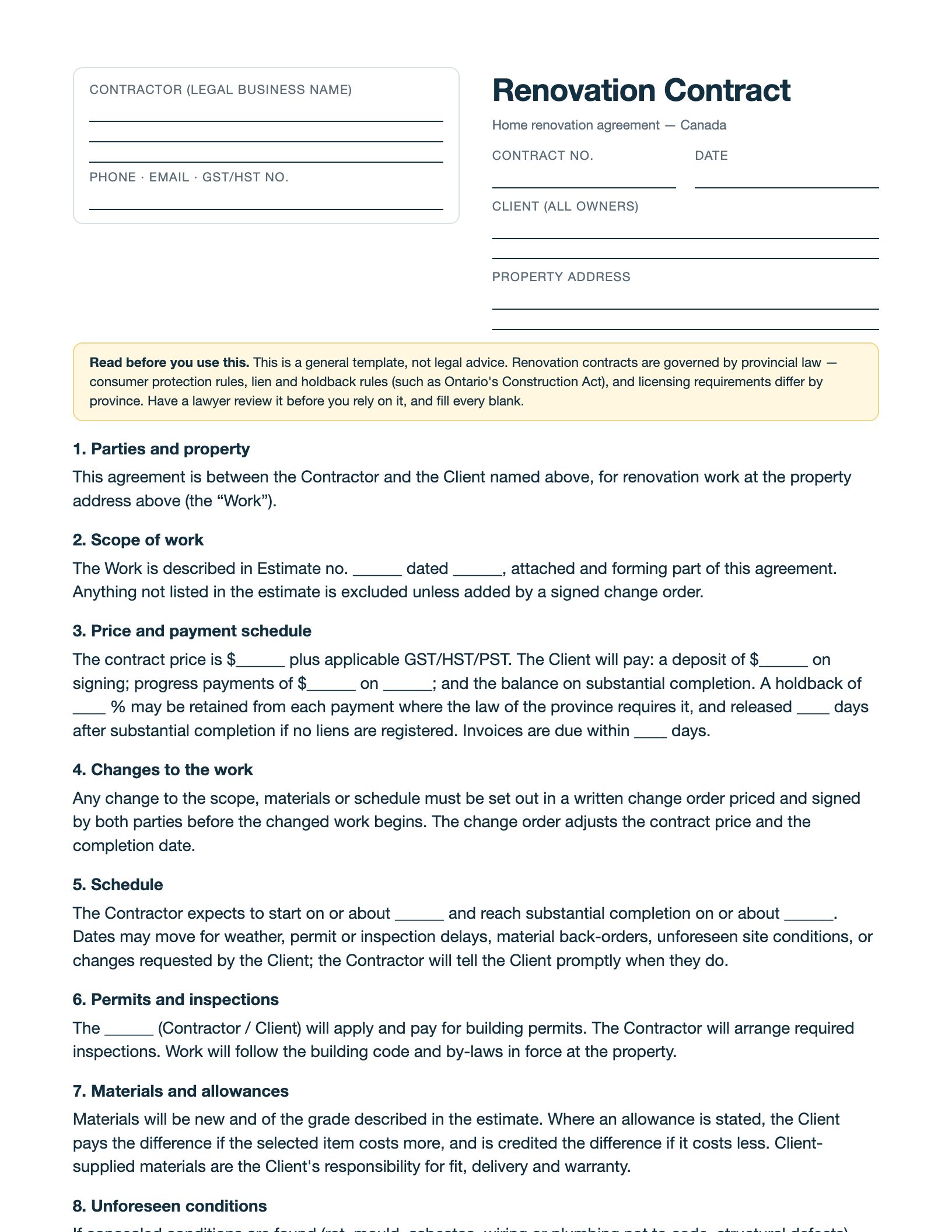
Fourteen plain-English clauses covering the things that actually go wrong on a renovation: scope creep, payment timing, holdback, hidden rot, who pulls the permit, and what happens if someone walks. Free PDF or Word file. Have a lawyer read it before you rely on it.
Free for any contractor to use, edit and put their own name on. Not legal or tax advice — rules differ by province and state.
The contract points at the attached estimate as the scope. Anything not in the estimate is excluded unless a signed change order adds it.
Deposit, progress draws, balance on substantial completion, and a holdback line with a release period — the mechanism Ontario's Construction Act and other provincial lien laws expect.
No changed work without a priced, signed change order. Pair it with the change order template.
Start and completion dates that can move for stated reasons, and a clause for the rot, mould, asbestos or bad wiring nobody could see.
Who applies and pays for permits, that materials are new and as specified, and how allowance items settle up or down.
General liability and provincial workers' compensation (WSIB in Ontario), with certificates on request. The client is reminded to check their home insurance.
A workmanship warranty period you fill in, a cancellation clause that respects provincial cooling-off rules, and mediation before anything else.
A handshake and an estimate is how most small renovation jobs start, and it works right up to the day it doesn't. The contract does not need to be long. It needs to say what the price includes, when money changes hands, how changes are handled, and what happens when a wall opens up and the joists are gone.
This template is written in plain English for a homeowner to read in ten minutes, because a contract the client does not read is a contract you will be explaining in a dispute. Every blank must be filled. Rules on consumer cooling-off periods, licensing, and lien holdback differ by province, which is why the first thing on the page is a warning to have a lawyer look at it.
In Estiquik, a contract is drafted from the estimate on the Pro plan, sent for e-signature, and the signed copy is filed with the job alongside every change order. The template is free for anyone.
It is a general Canadian template. Contract law, consumer protection, licensing and lien rules are provincial, and some are strict: Ontario's Construction Act sets holdback at 10% for 60 days, Quebec has its own civil-law regime, and several provinces give homeowners a cooling-off period for agreements signed at home. Have a lawyer in your province review it. This page is not legal advice.
There is no single national rule. A deposit that covers materials ordered before work starts is common practice; some provinces limit deposits on certain consumer contracts, and Ontario's Tarion rules apply to new homes rather than renovations. Put the number in the contract and say what it covers.
Holdback is a share of each payment retained until the lien period after completion has passed, so subcontractors and suppliers who were not paid have something to claim against. Ontario requires 10%; other provinces have their own rules. The template has the blanks; your province's law fills them.
It is written for residential renovation with a homeowner as the client. Commercial work usually calls for a CCDC form or a lawyer-drafted agreement.
On the Pro plan a contract is drafted from the estimate, sent for e-signature with an audit record, and filed with the job. The template here is free and needs nothing from us.
Estiquik builds the estimate, turns it into the invoice, the contract and the change orders, and fills in your province's tax. Free plan, no card.